
Fixing a broken iPhone starts long before you pick up a screwdriver. It starts with knowing exactly what you are buying. The market for iPhone spare parts runs from pulled factory displays down to thick TFT copies that cost a fraction of the price, and the gap between them shows up the moment the phone boots.
Pick the wrong part and the damage is not always visible. Face ID stops enrolling. True Tone disappears from the Control Centre. The battery menu hides the health percentage and throws a warning instead. None of these problems are fixed by a second attempt with the same part.
This guide covers the panel grades sold in the Pakistani market, how the sensor hardware pairs with the logic board, and the steps technicians follow to keep every feature alive after a repair. Useful whether you are fixing one phone at home or stocking a counter with mobile phone parts.
iPhone Panel Grades in the Pakistani Market
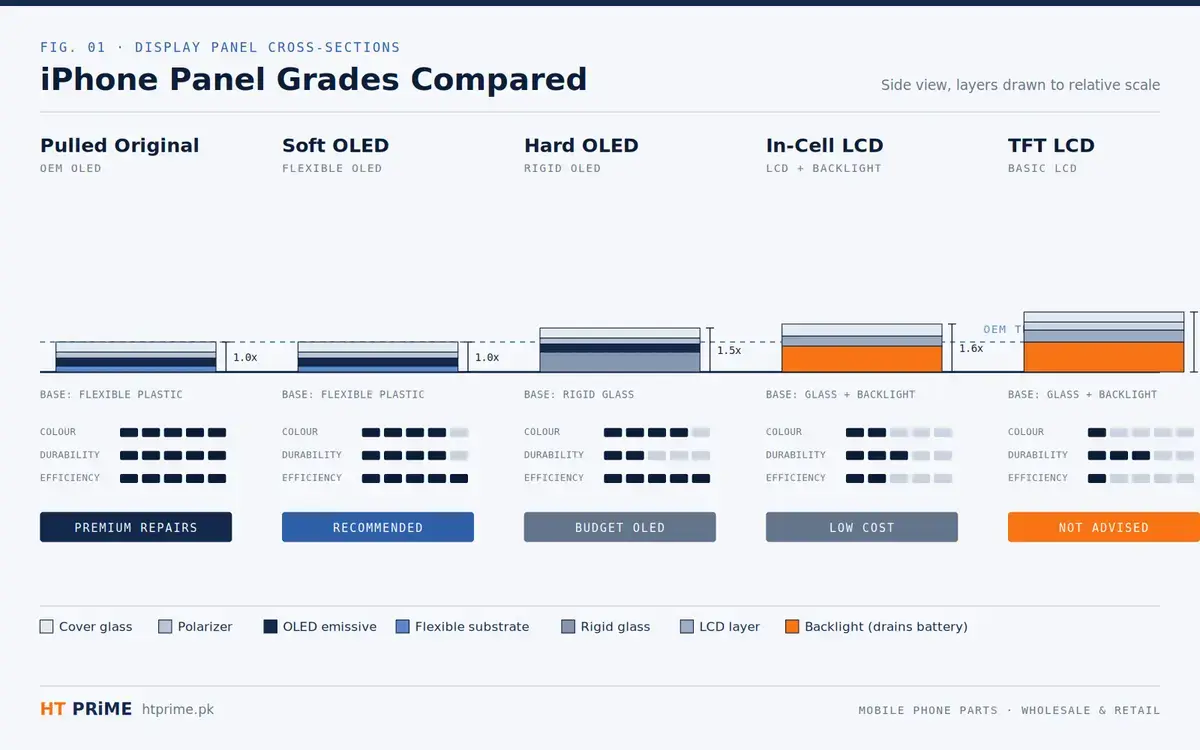
Walk into any electronics market in Lahore, Karachi or Hafizabad and ask for an iPhone screen. You will get four or five prices for what looks like the same part. Here is what separates them.
Pulled Original (OEM)
Authentic Apple displays harvested from dead or water damaged devices. Brightness, contrast and touch response match the factory panel because it is the factory panel. Best suited to premium repairs where the customer cares more about the result than the invoice.
H3: Soft OLED
Apple has used flexible Soft OLED in its own screens since the iPhone X. Aftermarket Soft OLEDs copy that flexible plastic base, which helps them survive drops. Deep blacks, low power draw on dark wallpapers, and colour that sits close to original. This is the sweet spot for most repair shops.
Hard OLED
Same OLED technology but built on rigid glass instead of flexible plastic. Cheaper, and noticeably more fragile. The glass base also adds thickness, so the panel tends to sit slightly proud of the frame after assembly.
In-Cell LCD
An LCD substitute for phones that shipped with OLED. Touch sensor and display layer are combined, and a backlight sits behind everything. Battery drains faster, blacks look grey, and whites carry a cold blue tint. Budget option only.
TFT LCD
The bottom of the range. Thick assembly washed out colour, laggy touch. Most technicians who care about repeat customers avoid it entirely.
Panel Grade Comparison Table
| Grade | Display Tech | Colour Accuracy | Drop Resistance | Battery Impact | Typical Use |
| Pulled Original | OEM OLED | Excellent | High | Lowest | Premium repairs |
| Soft OLED | Flexible OLED | Very good | High | Low | Standard shop repairs |
| Hard OLED | Rigid OLED | Good | Low | Low | Budget with OLED look |
| In-Cell LCD | LCD + backlight | Fair, blue tint | Medium | Higher | Low-cost repairs |
| TFT LCD | Basic LCD | Poor | Medium | Highest | Not recommended |
Knowing these grades matters most when you buy wholesale mobile parts in bulk. A carton labelled simply "OLED" can contain either Soft or Hard panels, and the price difference is real.
Preserving Face ID During Repair
Replacing a display means moving the original front sensor array onto the new panel. Damage those sensors and Face ID is gone for good, with no software or part that brings it back.
Apple pairs the True Depth camera hardware to one specific logic board at the factory. That pairing covers the flood illuminator, the infrared camera and the dot projector. On models up to the iPhone 12, the flood illuminator rides on the ear speaker flex cable sitting behind the screen.
This is why you cannot buy a replacement flex for it. Fitting a third-party sensor flex breaks the security link with the motherboard, and the phone refuses to enroll a face.
Safe transfer steps:
- Warm the top front of the old screen to roughly 60°C to soften the adhesive. Higher heat risks the sensors.
- Place a small drop of pure isopropyl alcohol behind the sensor bracket to break down the glue.
- Slide a flat plastic tool under the sensor housing and lift the housing itself. Never pull on the ribbon.
- Keep fingers clear of the optical lenses. Skin oil on the dot projector alone is enough to cause scan failures.
True Tone Transfer Workflow
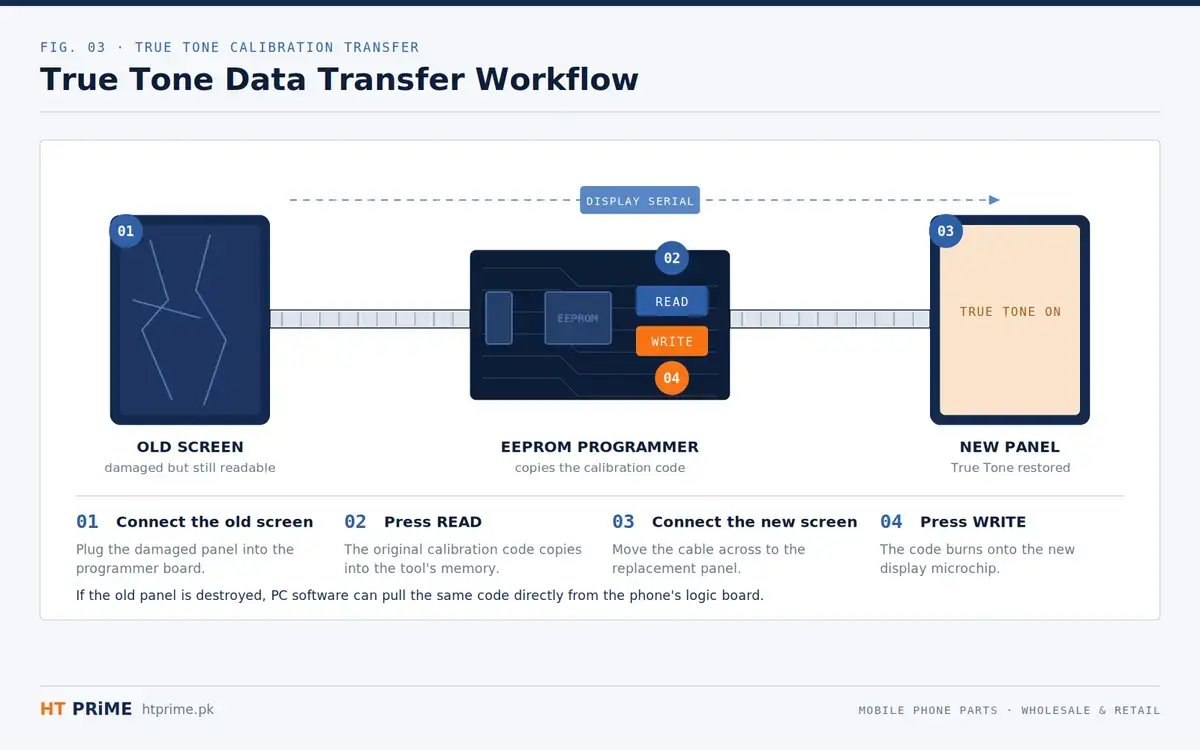
True Tone reads ambient light and shifts screen colour to match the room. Swap the panel without moving the calibration data and the feature vanishes, even if you fitted a genuine Apple display. The phone is looking for a serial number stored on the screen's own microchip.
Technicians copy that data with an EEPROM programmer.
- Connect the old screen to the programmer board.
- Press read to pull the display code into memory.
- Connect the new screen.
- Press writes to burn the code onto the new chip.
If the old panel is missing or too damaged to read, dedicated PC software can pull the same code straight from the logic board instead. It takes longer and needs a working data connection to the phone, so reading from the old screen is always the first choice.
Battery Health Warning Messages
From the iPhone XS onward, Apple tied the battery management system board to the logic board. The BMS sits at the top of the battery, hidden under black tape.
Fit a new battery without carrying that board across and the phone posts an "Important Battery Message" in Settings. Battery Health stops reporting maximum capacity.
Nothing is actually broken. Charging works, the phone runs normally, and the cell behaves exactly as it should. It is a software lock, not a fault.
To keep the health percentage visible, the original BMS board has to be cut away from the old battery and spot welded onto the new cell. That needs proper battery welding equipment and a steady hand. Soldering a lithium cell directly is not an option, and shops without the right tool are better off telling the customer about the warning upfront.
Pre-Seal Testing Checklist
Never lay the waterproof adhesive until every function is confirmed. Opening a sealed iPhone a second time destroys the seal and puts the new screen at risk.
- Touch response: press an app icon and drag it slowly around the full border of the screen. If it drops, there is a dead zone.
- Proximity sensor: place a test call and cover the earpiece. The display should go black instantly.
- Face ID: open Settings and start an alternative appearance enrolment. If it scans, the sensors survived the transfer.
- Cameras: open the camera app and check both lenses for dust trapped during assembly.
- Earpiece: play a video and listen for distortion or low volume.
How to Choose the Right iPhone Spare Parts
A short buying framework for shops and resellers:
- Match the grade to the customer, not the invoice. A daily driver on an iPhone 13 deserves Soft OLED. A three-year-old handset being resold does not.
- Ask the supplier which OLED type is in the box. "OLED" on the carton is not a specification.
- Buy batteries and displays from the same supplier where possible. Mixed sourcing makes warranty claims harder to trace.
- Check for a return policy on dead-on-arrival panels. Even good batches carry a small failure rate.
- Stock the tools alongside the parts. An EEPROM programmer and a spot welder pay for themselves quickly once volume picks up.
Pros and Cons of Aftermarket iPhone Displays
Pros
- Much lower cost per unit, which keeps repair pricing competitive
- Soft OLED quality is close enough that most customers cannot tell
- Wide availability across models, including older handsets Apple no longer supports
Cons
- True Tone needs manual transfer on every single unit
- Quality varies between batches even from one supplier
- Hard OLED and In-Cell panels are visibly weaker on colour and durability
Frequently Asked Questions
Does a new screen fix broken Face ID?
No. Face ID hardware sits on its own flex cable, separate from the display. A new screen only restores Face ID if the cracked glass was physically blocking the sensor window.
Why does my new iPhone screen look blue?
Usually because an In-Cell LCD was fitted instead of an OLED panel. The other common cause is a technician who skipped the True Tone calibration transfer.
Will my iPhone stay waterproof after a screen repair?
No. A fresh adhesive frame gives basic dust and splash resistance, nothing more. Treat a repaired phone as water sensitive.
H3: What is the difference between Soft OLED and Hard OLED?
Soft OLED is built on a flexible plastic base, matching Apple's own design. Hard OLED uses rigid glass, which costs less but cracks more easily and sits slightly thicker in the frame.
Can True Tone be restored without the old screen?
Yes. PC software can read the calibration code directly from the logic board when the original panel is unreadable, though it is slower than copying from the old screen.
Final Thoughts
Most failed iPhone repairs trace back to two decisions: the grade of panel that went in, and whether the original sensor and BMS hardware made it across. Get both right and the phone behaves like it did before the drop.
HT Prime supplies iPhone spare parts across every grade, along with the tools needed to transfer True Tone data and BMS boards properly. Wholesale pricing is available for repair shops and resellers.
📞 +92 329-6564000 | 🌐 htprime.pk